
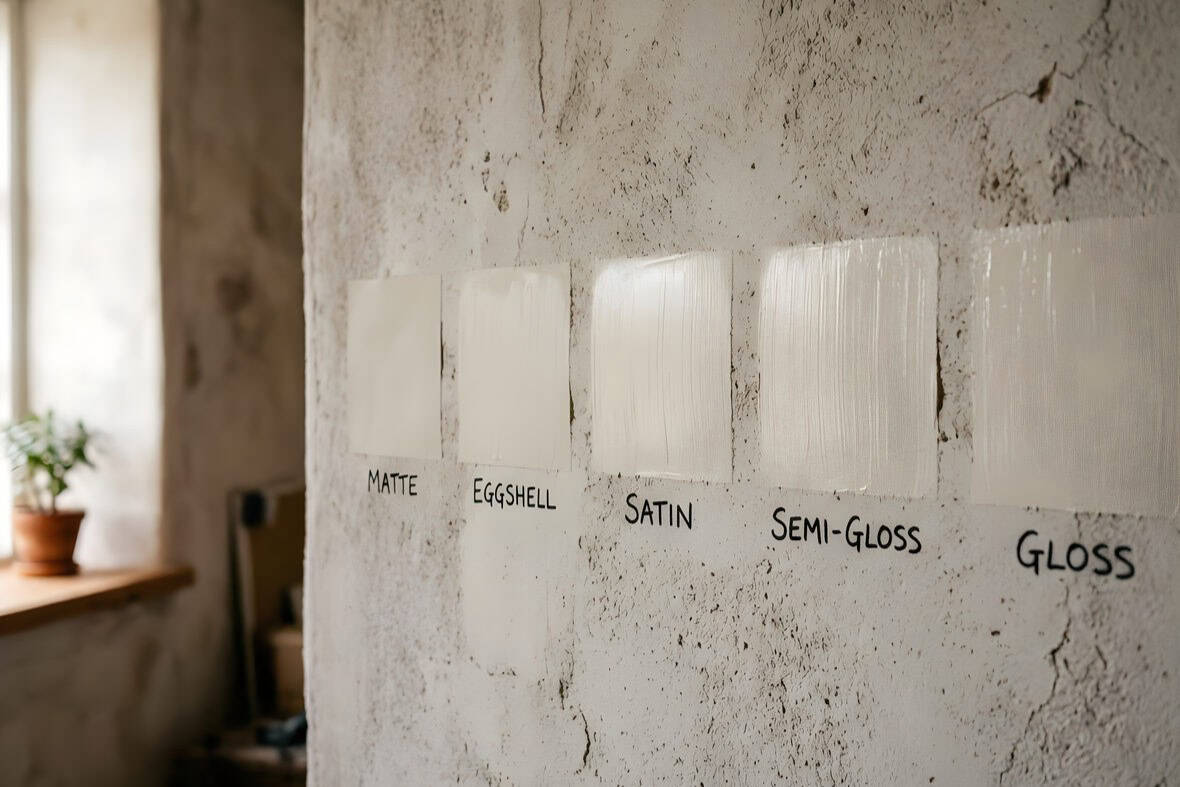
Alan Joyce has painted thousands of Berkeley homes over 37 years, and the sheen conversation happens on every interior job. Not because homeowners are confused about color, but because the right finish for a bedroom is wrong for a hallway, and the right finish for a bathroom painted with flat paint is a predictable failure. Sheen controls how light reflects off a dried paint film, how cleanable that surface is, and how forgiving it is of whatever lies underneath. Get it right, and the color you chose looks exactly as intended. Get it wrong, and every hairline crack in your plaster announces itself.
This interior paint sheen guide covers every finish from flat to high-gloss, with room-by-room recommendations built around Berkeley’s older plaster walls and coastal humidity.
Quick reference: - Ceilings: flat, always - Adult bedrooms and formal living rooms: eggshell - Family rooms, hallways, children’s rooms: satin - Kitchens and bathrooms: satin minimum, semi-gloss near moisture - Trim, doors, and baseboards: semi-gloss
Sheen measures how much light a dried paint film reflects back toward the viewer. The higher the sheen, the more directional and intense that reflection. The lower the sheen, the more light scatters and diffuses across the surface.
Don't trust the name on the label
Terms like "matte," "flat," and "eggshell" are not standardized across paint manufacturers. One brand's eggshell can have a higher sheen than another brand's satin. Before choosing a finish, check the sheen percentage range on the product's technical spec sheet, not just the marketing name on the front of the can.
What controls sheen at the chemistry level is the ratio of binder to pigment in the formula. Painters call this the Pigment Volume Concentration, or PVC. Paint with a high PVC (more pigment, less binder) reflects light in many directions at once, producing a flat, diffuse appearance. Paint with a low PVC (more binder, less pigment) dries to a harder, denser film that reflects light in a more focused way, producing sheen. That denser, lower-PVC film is also more washable and more durable under scrubbing.
The practical consequence: sheen choice is inseparable from wall condition. A higher-sheen film is harder and more cleanable, but its directional reflection shows every surface variation underneath. A lower-sheen film produces diffuse reflection that hides imperfections better. This is not a flaw in lower-sheen paints; it is how they are designed to work.
One more point before the room-by-room breakdown: terms like “matte,” “flat,” and “eggshell” are not standardized across paint manufacturers. Always check the sheen percentage range on the product spec sheet rather than relying on the name alone.
Flat paint reflects almost no light in a directional way. It contains the highest pigment concentration of any sheen level, which makes the dried film softer and less resistant to scrubbing. When a damp cloth scrubs flat paint, the soft extender pigment particles abrade away along with the dirt, leaving a slightly shiny streak where the film thinned. For a ceiling in a Berkeley craftsman with original plaster texture, flat is the correct call. For walls in a room where kids eat breakfast, it will show every mark.
Best for: Ceilings, low-traffic adult spaces, rooms with imperfect plaster walls where hiding texture is the priority.
Matte sits just below eggshell on the reflectance scale. Some manufacturers use “matte” and “flat” interchangeably; others place matte slightly above flat. In practical terms, matte behaves like flat: high PVC, soft film, poor scrubbability, excellent imperfection tolerance. The key difference is that some premium lines now offer washable matte formulas with a modified binder that improves cleanability without adding sheen. These are useful for low-traffic walls where a homeowner wants a flat look with slightly better durability.
Best for: Low-traffic accent walls, formal spaces, any surface where hiding plaster texture is the first priority.
Eggshell sits just above flat on the sheen scale with a barely perceptible luster that resembles the surface of a literal eggshell. It is the practical minimum for most living areas. Durability is noticeably better than flat; the surface handles an occasional wipe without degrading. Touch-ups blend more forgivingly than they do with satin, which is a real advantage in spaces repainted every five to seven years. Eggshell will not stand up to daily scrubbing in a high-traffic area, but it holds up well in rooms that do not receive that kind of use.
Best for: Adult bedrooms, formal living rooms, dining rooms, low-to-medium traffic walls.
Satin has a pearl-like mid-sheen that sits noticeably above eggshell. It is the most widely used residential interior finish because it handles the conditions most rooms actually produce: occasional cleaning, moderate moisture, foot traffic, and daily family life. Satin resists moisture well enough for kitchens and family rooms and tolerates scrubbing without losing its surface integrity. The trade-off: satin shows surface imperfections more than eggshell, so surface preparation starts to matter in a way it does not with lower sheens.
Best for: Kitchens, hallways, family rooms, children’s bedrooms, any room that sees regular cleaning.
Semi-gloss is noticeably reflective and is the professional standard for all millwork in residential interiors. It provides the visual contrast between wall and trim that makes a room look finished. Semi-gloss is highly durable, moisture resistant, and holds up to the constant contact that baseboards, door frames, and interior doors take over years of use. Any surface flaw shows clearly under semi-gloss, so thorough surface preparation is not optional before applying this finish.
Best for: Trim, baseboards, window casings, door frames, interior doors, kitchen and bathroom walls where moisture is a factor.
High-gloss delivers a near-mirror finish and maximum durability. The high binder concentration makes the film genuinely scrubbable and resistant to grease and staining. It also amplifies every surface defect, every brush stroke, and every roller stipple. For most residential interiors, semi-gloss performs nearly as well and is far more forgiving on imperfect substrates. High-gloss earns its place on kitchen cabinet doors, furniture pieces, and front doors where the look is intentional and the substrate is smooth enough to support it.
Best for: Kitchen cabinet doors, furniture, front doors, deliberate design statements on well-prepared surfaces.
Most homeowners treat the eggshell-versus-satin decision as an aesthetic one. It is not. The right choice depends on how much cleaning the walls will need and how good the surface condition is underneath.
Alan's rule of thumb after 37 years on real walls
Eggshell for formal spaces. Satin for anywhere kids, pets, or cooking come into play. If you are genuinely unsure which way to go, choose eggshell. Sheen can always go up on a repaint. Going back down means full prep all over again.
| Eggshell | Satin | |
|---|---|---|
| Reflectance range | ~10-25% | ~25-35% |
| Appearance | Subtle luster, soft | Pearl-like, slightly shinier |
| Cleanability | Wipeable, not scrubbable | Cleanable with gentle scrubbing |
| Imperfection tolerance | More forgiving | Shows flaws more readily |
| Touch-up ease | Good blend | Noticeable if mismatched |
| Moisture resistance | Low | Moderate |
| Best rooms | Adult bedrooms, formal living | Family rooms, hallways, kitchens |
| Prep requirement | Moderate | Thorough |
On a Berkeley plaster wall, the difference becomes more visible than homeowners expect. Older walls have hairline cracks, texture variation, and layers of historic paint that new drywall does not have. Under eggshell, those variations read as character. Under satin, they read as flaws. Not always, but more often than a homeowner expects when they see the fresh coat in direct light.
Alan’s general position after 37 years on real walls: eggshell for formal spaces, satin for anywhere kids, pets, or cooking come into play. If you are unsure, go with eggshell. Sheen can always go up on a repaint; going back down means full prep again.
Eggshell is the correct finish for formal living rooms and dining rooms with normal traffic. The lower sheen holds color more evenly under varied lighting and creates a warmer, quieter wall surface. Open-plan family rooms with daily use call for satin: satin handles the cleaning demands that come with actual family use. In either space, trim gets semi-gloss. The distinction between wall sheen and trim sheen is not just visual; semi-gloss on millwork signals a finished room in a way that matching sheens does not.
Adult bedrooms are eggshell territory. The lower sheen reads as restful and creates a warmer atmosphere under evening lighting. Children’s rooms need satin at minimum. Semi-gloss on the lower three to four feet of wall is a reasonable choice in rooms that see active daily use. That modest uptick in sheen is worth the cleaning convenience in a space that gets drawn on, touched, and tested every day.
Kitchen walls need satin at minimum. Near the cooktop and sink, where grease and steam concentrate, semi-gloss is the better call. Cabinet doors get semi-gloss or higher, depending on the style. Trim, door frames, and windows get semi-gloss throughout. In Berkeley kitchens with older plaster or wood paneling, eggshell on walls is a risk: moisture from cooking will eventually cause staining or peeling in a paint film that lacks the binder density satin and semi-gloss provide. Mildew-resistant paint formulas are the baseline choice for Berkeley kitchens, not a premium upgrade.
Flat paint in a full bathroom is a predictable failure. Moisture, steam, and mildew will find it. The porous surface of a flat paint film gives mildew more surface area to colonize than a semi-gloss film does. Bathroom walls need satin at minimum; semi-gloss is the better choice in a full bathroom that sees daily showers. Trim gets semi-gloss. The ceiling is the exception: flat works on bathroom ceilings because bathroom ceilings do not take direct steam contact the way walls do, and flat paint hides the texture variation common in Berkeley’s older plaster ceilings.
Berkeley’s marine layer adds to the baseline moisture load in every bathroom. Satin is the floor for bathroom walls, not a premium choice.
Hallways are high-contact surfaces that take shoulder rubs, bag knocks, and furniture scuffs that walls in other rooms never encounter. Eggshell does not hold up in this environment. Satin on the walls and semi-gloss on baseboards and door casings is the right combination. Children’s rooms follow the same logic.
Flat paint on ceilings, always. Overhead lighting fixtures create strong directional illumination on ceiling surfaces. Any sheen reflects that light back as glare, making the ceiling the most visible surface in the room rather than the least. Flat paint also hides the texture variation that is near-universal in Berkeley’s older ceilings. One more point: never match ceiling sheen to wall sheen. They are separate decisions. A satin ceiling in a room with satin walls reads as unfinished to anyone who notices it.
Semi-gloss is the professional standard for all millwork: baseboards, window casings, door frames, interior doors. These surfaces take constant touch, cleaning, and abrasion. Semi-gloss’s binder density handles that wear. It also creates the visual separation from the wall color that makes a room read as complete. Some contemporary interiors use satin on trim for a quieter, more monochromatic look, and this works in modern aesthetics, but it trades some durability.
A wall with minor nail pops, hairline cracks, or texture variation that reads as acceptable under eggshell will look rough under semi-gloss. The higher the sheen, the more the reflected light traces every dip and rise in the surface. This is physics, not a flaw in the paint.
Higher sheen without proper prep is not quality craftsmanship
On Berkeley plaster walls with hairline cracks or settling, applying satin or semi-gloss without thorough prep will highlight every surface variation under light. Patch, sand, and prime with a dedicated latex or oil primer first. Paint-and-primer-in-one products are adequate for drywall in good condition. On bare or compromised plaster, they underperform.
Sheen selection should happen after a realistic assessment of wall condition, not before.
The scenario Alan encounters regularly: a homeowner asks for semi-gloss walls throughout, and the existing plaster has hairline cracks from decades of settling. The correct response is to do thorough prep before the first coat: patch the cracks, sand the surface, apply a dedicated primer on the bare or compromised plaster. Plaster is more porous and more alkaline than drywall, and a dedicated latex or oil primer provides better adhesion than paint-and-primer-in-one products on a compromised substrate. All-in-one products are adequate for previously painted drywall in good condition. On bare or porous plaster, they underperform.
Applying the right sheen without proper preparation is not quality craftsmanship, regardless of how good the paint is. The prep determines what the finish can do. If the surface is not ready for the sheen the homeowner wants, the prep comes first.
Alan’s note: When I see a beautiful sheen on a wall that was not prepped properly, I already know what it is going to look like in six months. It is not the paint’s fault. Prep is what the sheen is resting on.
Sheen selection in a Berkeley home requires accounting for two factors a generic interior paint sheen guide will not mention: plaster walls that amplify imperfections under higher sheens, and marine-layer humidity that accelerates mildew in bathrooms and kitchens painted at too low a sheen.
The marine layer changes your recoat window
Berkeley's coastal humidity can run 60 to 90 percent during fog events in spring and summer. Water-based paints cure by releasing moisture into the air, and that process slows significantly in humid conditions. Applying a second coat too soon in a humid environment leads to adhesion failures and soft films that peel within the first year. Professional crews working in Berkeley's June fog season extend their recoat times to account for this. A rushed timeline during high-humidity months costs more to fix than it saved.
Berkeley’s marine layer brings relative humidity of 60 to 90 percent during fog events, particularly in spring and summer. For interior painting, this creates two specific problems.
First, cure time. Water-based paints cure by releasing moisture into the surrounding air. In high-humidity conditions, that process slows significantly. A second coat applied too quickly in a humid environment leads to adhesion failures and soft films that look fine at first and then begin to peel or mark easily. Professionals working in coastal conditions extend recoat times to account for this. A rush job during Berkeley’s June fog season will show problems within a year.
Second, mildew resistance. In Berkeley kitchens and bathrooms where ambient humidity is already elevated, selecting a paint with mildew-resistant additives and the appropriate sheen level (satin or semi-gloss) is the baseline, not an upgrade. Flat or eggshell in a full Berkeley bathroom is a choice that will need redoing within a few years. Premium interior paint lines now include built-in mildew-resistant technology as a standard feature, so specifying the right product for humid rooms no longer requires tracking down a specialty formulation.
Berkeley’s pre-1960 housing stock adds another layer. Plaster walls settle over decades. They develop hairline cracks, textured finishes, and layers of historic paint that create surface variation new drywall does not have. Flat and eggshell are forgiving of this. Satin requires good prep on older plaster. Semi-gloss demands it.
One more note on color: paints with strong blue or gray undertones can read colder than expected under fog-diffused natural light. Warm neutrals tend to hold more consistently across Berkeley’s varied lighting conditions throughout the day. Alan includes color consultation on every interior project and can walk through this before paint is purchased.
This guide gives you what you need to walk into any room, look at the walls and surfaces, and make an informed sheen decision. Knowing the right sheen for each space is the first step.
The rest of an interior painting project involves surface assessment, prep judgment calls on older plaster, application technique that prevents lap marks and uneven coverage, and getting the color right on the first coat. These are areas where 37 years of experience on Berkeley homes produces a different result than a weekend project.
A&J Painting Inc. offers professional interior painting in Berkeley with a free color consultation on every job and a 3-year interior warranty that covers peels, fades, and bubbles. Alan is on every job, not just the estimate. If you are planning an interior project and want it done without the guesswork, call A&J at (510) 292-3668 for a free estimate.
The right sheen depends on the room and the wall condition. Most living areas and adult bedrooms work well with eggshell or satin. Kitchens, hallways, and children’s rooms need satin at minimum. Bathrooms need satin or semi-gloss. Ceilings should always be flat. Trim and doors get semi-gloss throughout.
For a formal living room with moderate traffic, eggshell gives a softer, warmer look and blends better on touch-ups. For a family room or any living space with kids, pets, or daily heavy use, satin handles cleaning without degrading the surface. Wall condition also plays a role: older or textured plaster walls hold up better at lower sheens, so eggshell is often the more forgiving choice in Berkeley’s older homes.
Higher-sheen touch-ups are genuinely difficult. The sheen of the touch-up coat must match the original exactly, because even a small difference in reflectance shows under light. Test the touch-up in an inconspicuous spot first, and use leftover paint from the original job if available. Many professional painters choose to repaint a full wall section rather than spot-touch a semi-gloss finish, because isolated patches almost always read as patches.
Eggshell or satin on walls, flat on ceilings. Older plaster develops hairline cracks and surface variation that higher sheens amplify. Eggshell is more forgiving on imperfect substrates and provides enough durability for most living spaces. If satin or semi-gloss is the goal, plan for thorough surface preparation first: patching, sanding, and priming the plaster with a dedicated primer before the finish coat. Paint-and-primer-in-one products are not adequate for bare or compromised plaster.
Yes. Higher-sheen finishes make colors appear slightly deeper and more saturated because the surface reflects light in a more directional way. Flat and matte finishes make colors appear softer and slightly more muted. In Berkeley rooms lit by diffused fog-filtered light for part of the day, this effect is noticeable. Test a finish sample on the actual wall under the room’s actual lighting before committing to a color and sheen combination.
On trim, cabinets, and doors, semi-gloss is the correct call in any kitchen. On walls, it depends. In a bright kitchen with good lighting, semi-gloss on walls reads as clean and practical. In a darker or smaller kitchen, it can feel clinical. Satin is a reasonable choice for kitchen walls: durable and cleanable without the full reflective look. Either way, eggshell on kitchen walls is a choice that tends to show grease, steam staining, and wear within a year or two.
Pigment Volume Concentration is the ratio of pigment solids to total dry film volume in a paint formula. High-gloss paints typically have a PVC below 40 percent, meaning more binder, denser film, more durability, more reflectivity. Flat wall paints can run from 40 to 80 percent PVC, meaning more pigment, softer film, diffuse light scattering, and better imperfection tolerance. Understanding PVC explains why flat paint scrubs poorly (the soft extender pigment particles abrade away with the dirt) and why semi-gloss holds up to repeated cleaning.
About the author: Alan Joyce founded A&J Painting Inc. in 1999 and has 37 years of experience in the painting industry. A&J Painting serves Berkeley, Albany, El Cerrito, Richmond, Emeryville, Piedmont, and the broader East Bay. Licensed C-33 #759175. Lead Certified since 2002.
Looking for interior painting in Berkeley? Call (510) 292-3668 or visit the contact page.