
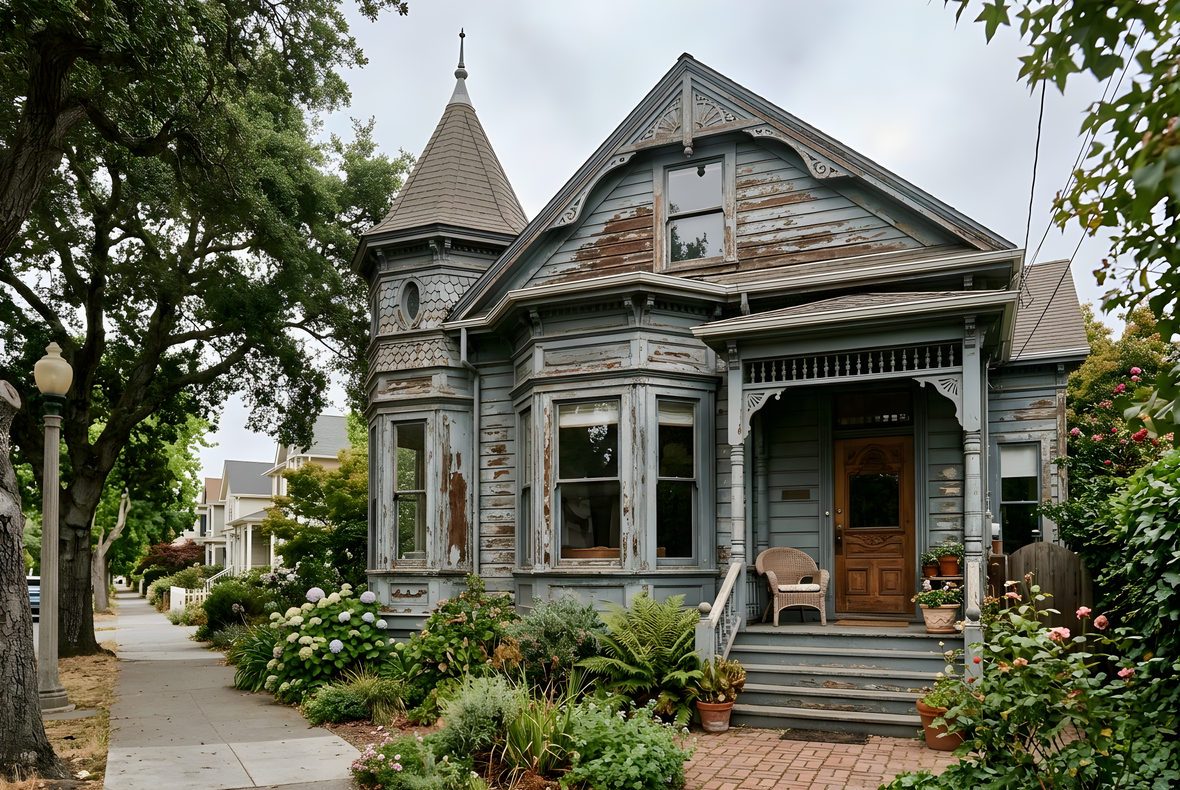
Berkeley has one of the highest concentrations of intact Victorian and Craftsman architecture in the Bay Area. Many of these homes are more than 100 years old and have been repainted dozens of times. They present specific challenges that modern construction simply does not.
This article is for Berkeley homeowners who own one of these homes and want to understand what painting it properly involves. Not just applying a coat, but doing it in a way that protects the wood, respects the architecture, and lasts through Berkeley’s particular climate.
I have been painting Victorian and Craftsman homes in Berkeley and the East Bay since 1999. These are my observations on what they require.
Understanding which category your home falls into shapes the entire approach.
Victorian homes (1880s-1910s): The four most common substyles are Queen Anne, Italianate, Eastlake, and Folk Victorian. Queen Anne is the most ornate: asymmetrical facades, bay windows, towers, wraparound porches, and extensive decorative trim including spindles, brackets, and dentil molding. Italianate homes are more restrained, with tall narrow windows and wide bracketed cornices. North Berkeley, the Elmwood neighborhood, and the Claremont district have high concentrations of Victorian homes.
Craftsman bungalows (1905-1930s): Low-pitched gabled roofs, wide overhanging eaves with exposed rafter tails, front porches with tapered columns, and a general preference for natural materials over ornamentation. The Claremont neighborhood and much of South Berkeley along Alcatraz and Ashby Avenues have significant Craftsman stock.
Brown shingles: A Bay Area regional vernacular using redwood shingles left to weather naturally, producing the distinctive brown-gray color. Many were never intended to be painted. If a brown shingle home has been painted at some point, the maintenance approach changes.
Stucco over wood frame: Common on 1920s and 1940s homes throughout Berkeley. Requires elastomeric paint to handle the ongoing micro-movement in the substrate. Standard exterior paint on stucco cracks with building movement and allows water infiltration.
Victorian homes reward preparation and attention that most exterior painting projects never require.
Timing Matters: Do Not Paint Wet Wood
Berkeley's marine fog saturates wood siding overnight, particularly on north-facing walls and shaded elevations. Painting over wet or damp wood traps moisture beneath the film, which causes blistering and peeling within months, regardless of paint brand or quality. In Berkeley's summer fog season, that often means waiting until 10 or 11 a.m. before starting on affected surfaces. A painter who starts at 7 a.m. on a foggy morning and immediately begins applying paint is skipping a step that determines how long the job lasts.
A proper Victorian exterior typically uses three to five colors: body, primary trim, secondary trim, sash, and an accent for spindles, brackets, or other ornamental elements. These color relationships need to be considered as a whole.
The purpose of a multi-color scheme on a Victorian is to highlight the three-dimensional quality of the architecture. Light colors on projecting elements appear to advance. Deeper colors on receding surfaces appear to recede. Done well, this makes the architectural detail read clearly. Done poorly, it flattens or muddles the design.
Color consultation is included in every A&J estimate. On a Victorian, that conversation takes time and it is time well spent.
Victorian trim accumulates paint over generations. When the layers fail, they often fail together in sheets because the combined package has become too thick and too inflexible. Proper prep involves examining which trim elements, spindles, and brackets have significant buildup and addressing them before new paint goes on.
For severely built-up trim, stripping is sometimes necessary. A contractor who does not mention paint buildup when looking at a Victorian with 50-plus years of paint history may be skipping a necessary assessment.
Berkeley’s morning fog and dew saturate wood siding, particularly on north-facing walls and areas under tree canopy. Painting over moist wood traps that moisture and causes the paint to blister and peel within months.
I do not start painting until surfaces have fully dried, which in Berkeley’s summer fog season often means waiting until late morning. That timing discipline is part of what makes a paint job last.
Original Victorian wood often has very old, very hard paint layers beneath. The primer coat needs to bond to that aged surface and provide a compatible base for the topcoat. Bare wood, stable old paint, repaired areas, and galvanized metal all have different primer requirements.
Craftsman homes present a different set of considerations than Victorians.
Craftsman design uses exposed rafter tails, knee braces, and porch columns as aesthetic elements. Rafter tails and exposed wood at the roofline are among the first places paint fails on older Craftsman homes because of their direct weather exposure. Those roofline elements need close inspection for rot or deterioration before paint goes on.
Wood shingle siding absorbs paint differently than smooth-surface lap siding. Multiple thin coats adhere better than one thick coat. Brush application is often more effective than spray for the first coat, so the paint works into the textured shingle surface rather than sitting on top of it.
Traditional Craftsman colors work with the architecture: warm browns, forest greens, slate blues, soft yellows, and terracotta reds. These complement the horizontal lines and natural materials Craftsman design is built around. Modern gray-dominant palettes can conflict with that warmth. I will tell you when I think a color choice is fighting the architecture. You still decide.
Craftsman homes often have wood porch floors that require porch paint or floor stain, a separate product from exterior house paint, formulated for foot traffic. This is easy to leave out of an estimate if the scope is not specific. Confirm it is included explicitly if you want the porch floor done.
Color selection for a Victorian or Craftsman home is a different process than choosing colors for a modern house.
Berkeley Historic Districts: Know Before You Paint
Berkeley has several designated historic districts, including portions of Claremont, Elmwood, and the Northbrae neighborhood. Homes within these districts, or homes with individual Landmark designation, may require approval from the Landmarks Preservation Commission before an exterior color change.
This is not universal, and it does not apply to routine repainting in the same colors. However, if you are changing the color scheme significantly on a home in a historic district, a quick check with the City of Berkeley Planning Division before you commit to colors is worth the time. We flag potential review requirements as part of our consultation so you are not caught off guard mid-project.
Sample Colors on the House Itself, Not Just a Chip
Paint chips under fluorescent lighting at a store tell you almost nothing about how a color will read on an exterior surface in Berkeley's light. Before committing to a color scheme, paint a generous sample patch (at least 12 by 12 inches) on each distinct surface: siding, trim, and any accent elements. Then observe those patches at three points in the day:
Morning
Diffuse fog light. Cooler tones, especially blues and grays, tend to flatten and read dull.
Midday
Direct light reveals undertones. A "warm gray" may read strongly green or purple at this angle.
Afternoon
Warm raking light. Yellows and ochres can shift orange; some greens look brighter than expected.
Color consultation is included in every A&J estimate. If you are deciding between two or three options, this step prevents an expensive mistake.
Victorian color schemes should emphasize the architectural details that define the style. A Victorian painted in a single body color loses the dimensional quality the architecture was designed to express. Color planning means identifying the different component zones: body, primary trim, secondary trim, sash, accent. Each one plays a role.
1890s Queen Anne Victorians commonly used warm terracottas, forest greens, and ochres. Craftsman homes were typically painted in natural earth tones. The Berkeley Architectural Heritage Association (berkeleyheritage.org) and the Berkeley Historical Society both have resources on period-appropriate colors. Paint manufacturer historical collections are another source.
Colors that look similar on a small chip look very different on a house. Berkeley’s light quality adds a variable: the Bay Area’s marine-influenced overcast diffuse light reads colors differently than direct inland sun. A warm gray with green undertones and a warm gray with purple undertones look similar on a chip and quite different across 2,000 square feet of siding.
Exterior colors should be sampled on at least three surfaces in both morning and afternoon light before you commit. Morning fog light and afternoon sun in Berkeley produce noticeably different readings of the same color.
If your home is in a Berkeley historic district or has Landmark designation, exterior color changes may require review by the Landmarks Preservation Commission. I am familiar with Berkeley’s local preservation guidelines and can flag potential review requirements before color selection begins.
After 26 years working as a painting contractor in Berkeley, I have seen the same problems repeatedly.
Pre-1978 Homes: What EPA Lead-Safe Certification Actually Means
If your Berkeley home was built before 1978, federal law requires any contractor disturbing painted surfaces of more than a certain area to follow EPA Renovation, Repair, and Painting (RRP) protocols. This is not optional and it is not a checkbox. It means specific containment procedures, defined methods for minimizing dust, and proper disposal of debris.
Ask any contractor bidding on a pre-1978 home whether they are EPA Lead-Safe Certified. If they cannot produce their certification number, they are either non-certified or relying on a certificate they cannot verify. A&J has been EPA Lead-Safe Certified since 2002 (Certification #R-I-19157-22-01220). The protocols add time to prep work. That time is the point.
Peeling paint at window sills and frames: The most common failure point. Water infiltration from rain and condensation saturates wood at sills, and the paint film ruptures from moisture trapped below. Remedy: proper caulking, addressing failed glazing compound, appropriate primer.
Lead paint layers: Most Berkeley homes built before 1978 have lead paint somewhere in their paint history. Intact lead paint that is not disturbed poses minimal risk. A&J is EPA Lead-Safe Certified and follows RRP protocols on all pre-1978 homes.
Failed caulk: Old caulk hardens, cracks, and separates. Painting over failed caulk seals in the failure and accelerates how quickly new paint peels around windows and doors. The correct process is removing the old caulk completely, cleaning the joint, applying fresh elastomeric caulk, and allowing it to cure before painting.
Galvanized metal oxidation: Many Victorian-era homes have galvanized gutters, downspouts, and decorative metal elements. Galvanized metal has a zinc oxide layer incompatible with most standard primers. The wrong primer results in paint that peels in sheets within a year or two. A galvanizing primer is required before the topcoat.
Paint buildup on decorative trim: After generations of repainting, decorative trim can have so much accumulated paint that original profiles are obscured. Significant buildup also creates adhesion problems. Chemical or heat stripping followed by proper prep can restore the original profile.
Most Victorian exteriors use three to five colors: body, primary trim, secondary trim, sash, and one accent. Using fewer colors tends to flatten the architecture. The goal is to use color to make the architectural detail more readable.
Some Berkeley homes are in historic districts or have Landmark designation. These homes may require review for exterior color changes. I can help identify whether your home has any relevant constraints before color selection begins.
Not necessarily. If existing paint is adhering well, proper prep (wash, scrape where loose, sand feathered edges, spot prime) is sufficient. Stripping is appropriate where paint buildup is obscuring architectural detail or where widespread adhesion failure is present.
A Victorian with complex trim and multiple colors typically takes 8 to 12 days, compared to about 6 days for a simpler home. The extra time comes from complex detail work, multiple masking changes between colors, and careful work around ornamental trim.
Several paint manufacturers produce historical color collections tied to specific architectural periods. I walk through period color research with clients as part of the consultation process.
Victorian and Craftsman homes in Berkeley are some of the most architecturally interesting residential work a painting contractor gets to do. They require quality craftsmanship and punish shortcuts.
Contact A&J Painting Inc. at (510) 292-3668 or through our contact page.
Alan Joyce has been in the painting trade since 1988 and has operated A&J Painting Inc. in Berkeley since 1999. He is on every job and backs his work with a 5-year exterior warranty.
Looking for a painting contractor in Berkeley who specializes in Victorian and Craftsman homes? Call (510) 292-3668 or visit the contact page.