
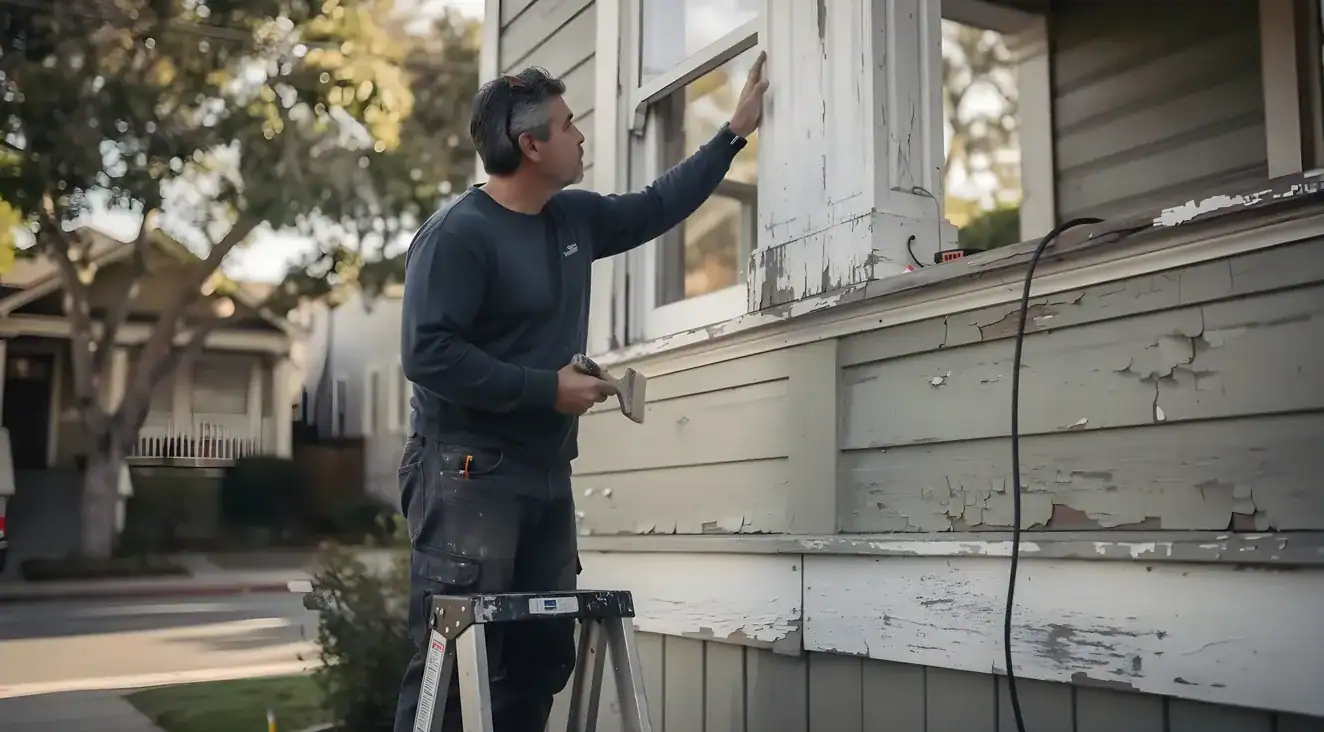
Exterior paint typically lasts 5 to 10 years, though the real answer depends on the surface, the prep work behind it, and where in the East Bay your house sits. Alan Joyce has painted homes across Berkeley and the East Bay for 37 years, and has seen paint jobs fail in three years and others hold up past fifteen. The difference almost never comes down to luck, but to a handful of factors homeowners can control, plus a few Bay Area conditions most exterior-paint articles never mention. This guide covers realistic lifespans by surface type, why Berkeley’s fog and microclimates change the math, and what determines whether your next paint job lasts five years or fifteen.
Exterior paint lifespan depends on the substrate, and lumping every surface into one number is where most articles get it wrong.
At a glance: the best and worst case for longevity
Longest-lasting: fiber cement and hardboard
10 to 15 years with proper prep. The material does not move or absorb moisture the way raw wood does, so the paint film has less to fight.
Shortest-lasting: trim, fascia, and doors
Usually 3 to 7 years. These surfaces take the most direct sun and weather exposure, so they often wear out before the siding shows any sign of trouble.
Wood siding is the trickiest range to pin down, because it depends almost entirely on prep and product quality. On an average job with standard-grade paint, wood siding holds up 3 to 7 years, shortened to 2 to 4 years by poor prep or heavy sun and moisture exposure. With thorough surface preparation and a premium-tier product, the process A&J Painting is built on, wood siding can hold up closer to 7 to 10 years, sometimes longer on sheltered sides of the house.
Stucco typically lasts 5 to 8 years, up to 10 with strong prep. New stucco needs roughly 30 to 60 days to cure before it can be painted at all; painting too early traps moisture underneath and causes early failure.
Fiber cement and hardboard siding hold up the longest, typically 10 to 15 years with proper prep. The material does not move or absorb moisture like raw wood, so the paint film has less to fight.
Trim, fascia, and doors take the most direct sun and weather exposure of any exterior surface, usually wearing out in 3 to 7 years. They are often the first place to show wear even when the siding itself still looks fine, so check them yearly.
At a glance:
| Exterior Surface | Typical Repaint Interval |
|---|---|
| Wood siding, average prep | 3-7 years |
| Wood siding, thorough prep and premium product | 7-10 years |
| Stucco | 5-8 years |
| Fiber cement / hardboard | 10-15 years |
| Trim, fascia, doors | 3-7 years |
Most exterior-paint advice online is written for climates with long dry summers and hard freezes, neither of which describes Berkeley. The Bay Area’s marine layer changes the equation in ways generic articles never mention.
Which side of your house to check first
North and west-facing walls take the brunt of Berkeley's marine layer, cycling wet and dry more than the rest of the house. When you do your yearly walk-around, start there. If those walls are holding up, the rest of the house usually is too.
Fog deposits moisture on siding even without rain, especially on north and west-facing walls facing the bay. That moisture dries and returns as the fog cycles, and the repeated wet-to-dry stress affects the paint film differently than steady sun exposure does. Alan has watched the north and south sides of the same Berkeley Hills home wear on different schedules, not from perception, but because each side faces different conditions every day.
Microclimates within the East Bay compound this. Homes in the Berkeley Hills, generally above the marine layer’s usual ceiling, get more consistent direct UV and bigger day-to-night temperature swings. Homes in the flatlands near the bay sit in the fog more often, with more damp-to-dry cycling and cooler temperatures. Warmer inland cities like El Sobrante and Hercules see more direct UV and fade faster. Two houses a few miles apart can be on different repaint schedules for real physical reasons, not guesswork.
Here is a myth worth correcting: fog does not mean your house is protected from sun damage. Most days the fog burns off by afternoon and the same house still gets hours of direct sun. UV keeps breaking down the paint’s binder, causing fading and chalking, on a schedule different from a drier, sunnier climate.
Rain season runs roughly November through March in the East Bay, and paint already failing going into that stretch will not survive it intact. Water finds its way behind the film, bubbles form, and exposed wood starts absorbing moisture. The extended damp periods also raise mildew risk compared to drier parts of California, so proper prep means removing existing mildew, not painting over it.
Surface preparation determines more about how long paint lasts than any other single factor. Surfaces need to be clean, dry, and stable before a drop of paint goes on: power washing, scraping away failing paint, sanding rough edges, priming bare wood, and caulking gaps where water could get behind the film. Skip any of these steps and paint has nothing solid to bond to; prep failures usually show up within the first year or two as bubbling or peeling.
Paint quality matters too, not as a specific brand but as a quality tier. Premium-grade acrylic products hold up measurably longer than entry-level paint because the resin resists UV and temperature swings better. Two full coats reach the protective thickness the product is designed to deliver; one coat is a shortcut that shows within a few seasons.
Application conditions matter more than most people realize. Paint applied in direct sun, extreme heat, or right before rain will not cure properly, and an undercured film fails early no matter how good the product is. In the Bay Area, that means timing the work around the same-day swing from morning fog to afternoon sun, not just checking the weekly forecast.
Color choice plays a smaller role: very dark colors absorb more heat, expand and contract more through the day, and tend to fade faster than lighter shades. That is not a reason to avoid a dark color you love, just something to factor into how often you plan to repaint.
Seven checks tell you whether your exterior paint is failing: chalking, fading, peeling, cracking, mildew, exposed wood, and cracked caulk.
Three checks that take five minutes
The hand test
Run your palm along the siding. Powdery residue means chalking has already set in.
The caulk line
Look at every joint. Cracked or pulling caulk is often the earliest warning sign of all.
The shaded spot
Compare a spot under an eave to one in direct sun. A visible gap in color means uneven aging is underway.
Catching any of these early keeps the project smaller: less prep, no wood repairs, a lower total cost. Wait too long and the job needs the failed paint stripped or scraped before new paint goes on, meaning you pay for prep twice. If timing your project around the calendar matters too, our guide to the best time of year to paint in the Bay Area covers that separately.
A warranty is not a marketing add-on. It is a signal.
A&J Painting's 5-year warranty
Every exterior job carries a 5-year warranty covering anything that peels, fades, or bubbles, repaired at no charge. Alan Joyce has built the process behind that warranty over 37 years in the trade, and it only holds up because prep and quality craftsmanship come first, every time.
Contractors who prepare surfaces properly and use quality materials can stand behind their work for years, because they know what is under the paint film. One who cuts prep corners cannot offer a multi-year warranty and survive the claims that follow.
A&J Painting’s exterior work carries a 5-year warranty covering anything that peels, fades, or bubbles, repaired at no charge. That is not a vague satisfaction guarantee, it is underwriting the exact failure modes covered above, and it only makes sense if the process behind it was right in the first place.
If you are evaluating exterior painting services for your home, ask any contractor what their warranty actually covers, and for how long. The answer tells you more about their process than their sales pitch ever will.
Paint longevity affects your budget directly: a paint job that costs more upfront but lasts twice as long almost always costs less per year than a cheaper job that fails early.
Here is the logic, using round numbers as an illustrative example only, not a real A&J quote: a paint job that lasts 12 years costs roughly its total price divided by 12 per year. A lower-quality job at a similar price that only lasts 6 years roughly doubles that per-year cost, and usually needs more prep going in because the first coat failed and left a mess behind. It is the difference between paying once for quality craftsmanship and paying twice for a shortcut.
If you are weighing that math for your own home, take a look at how we approach exterior painting in Berkeley.
It depends heavily on the prep work done before the paint went on. Standard-grade paint on averagely prepped wood siding typically holds for 3 to 7 years, and can fail in as little as 2 to 4 years if the prep was rushed or the exposure is harsh. A properly prepped job using a premium-tier product stretches that closer to 7 to 10 years, sometimes longer on sheltered sides of the house. Prep quality and product tier explain almost the entire gap.
Plan on a repaint somewhere in the 5 to 10 year window for most Berkeley and East Bay homes, though your specific substrate and sun exposure will narrow that down. Walk the exterior once a year and pay closest attention to the north and west-facing walls first, since those take the most fog and moisture in this part of the Bay Area.
Surface prep is the single biggest lever homeowners have, by a wide margin. A clean, dry, stable surface before painting matters more than almost anything else. Beyond that, choosing a premium-tier product and making sure the crew applies two full coats, not one, adds real years to the finished job.
Chalking residue on your hand after touching the siding, visible fading compared to a shaded area, peeling or bubbling paint, cracking, mildew or dark streaking, exposed bare wood, and caulk pulling away from joints are all indicators. Caulk failure often shows up before the paint itself looks bad, so it is worth checking separately.
It can, particularly on walls facing north and west toward the bay. The daily cycle of fog moisture followed by afternoon sun stresses the paint film differently than a straightforward dry, sunny climate would, and fog does not block UV damage the way people assume. Homes higher in the Berkeley Hills or further inland often end up on a different repaint timeline than homes closer to the flatlands, simply because they experience different weather every day.
A warranty does not change the physics of how paint ages, but it does tell you something important about the contractor. Only a contractor confident in their prep work and product choice can afford to back a job with a multi-year guarantee. A 5-year warranty on exterior work is a strong signal the process behind it was done correctly the first time.
Sometimes, but only if the existing paint is genuinely sound, meaning no peeling, chalking, or cracking, and the surface is clean and dry. Painting directly over paint that is already failing just seals the problem in and shortens the life of everything applied on top of it. This is why an honest inspection needs to happen before any new paint goes on, not after.
A lasting paint job comes down to doing the work properly the first time: thorough prep, quality materials, and skilled application, in that order. Alan Joyce has been painting homes across Berkeley and the East Bay for 37 years, holds a C-33 Contractor License (#759175), and has been Lead-Safe Certified since 2002. Every exterior job A&J Painting completes carries a 5-year warranty covering anything that peels, fades, or bubbles, because that is what quality craftsmanship should be able to stand behind.
If your home is showing any of the signs above, or you just want an honest read on where your paint job stands, call A&J Painting at (510) 292-3668 for a free estimate.
Looking for exterior painters in Berkeley or the East Bay? Call (510) 292-3668 or visit the contact page.